UNOFFICIAL OFFICIAL WEBSITE JAPAN
U.O.W.J.
Japanese culture, language, etc.
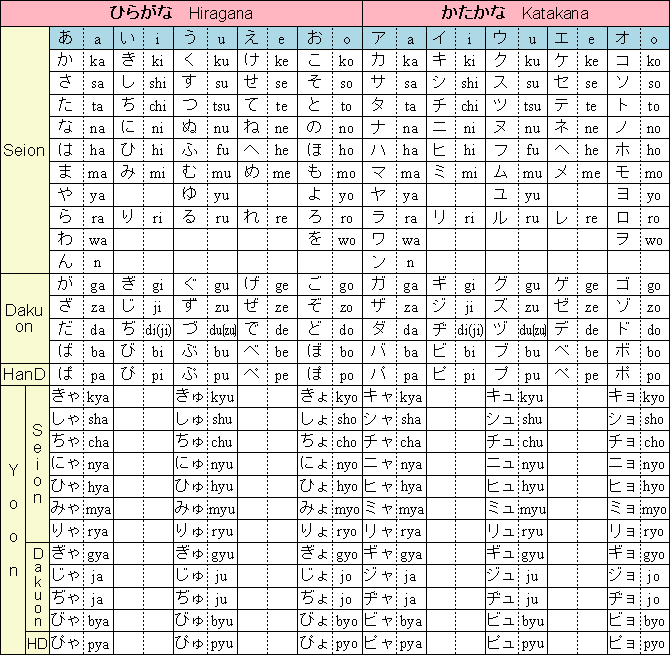
Japan's primary language is, you guessed it, Japanese. Japanese can be quite complex at times with its three different alphabets: Kanji, Hiragana, and Katakana. The most commonly used alphabet, and by far the easiest to learn is Hiragana, a phonetic alphabet. Hiragana was originally pioneered from the Chinese way of writing; however, it didn't gain traction in popularity until many thousands of years after it was created due to the fact that people believed that Chinese was the absolute correct way of communicating. The reason that Hiragana has become so popular is due to the fact that women usually wrote with it since they were considered not equal to men. Female writing were passed down quite often which caused the alphabet to raise in stature in later years.
Katakana drew the real legacy in early Japan as a short hand for writing Chinese, the official communication at the time; however, many years later, it gave way to Hiragana. Like Hiragana, Katakana is phonetic.
Kanji ia by far the most confusing and oldest languages. Unlike either of the two alphabets, Kanji isn't phonetic. Instead, each character represents a word or idea. Learning and masteing Kanji takes many years of practice.
The Japanese language, itself, follows a very strict and oftenly confusing formal hiarchy. Japan's culture also reflects this hiarchy. Take, for example, the simple Japanese words "Kohai" and "Senpai." They are suffixes used for names to indicate anothers stature comparitive to you. A senpai is anyone older than you or of a higher position than you. A kohai is anyone younger than you or of a lower position than you. This may seem all too simple, but it is not for there are different levels for each type of senpai or kohai. In exaple, talking to a person that is slightly older than you you would talk in a slightly formal manner. When talking to someone's grandparents, you would talk in a very formal and respected manner. This doesn't mean simply being kind. This means throughing other very formal words in. English, unlike Japanese, has very little of these types of words but we'll use miss, madam, and boss for example. To a coeworker just older than you, you'd say miss. To one much older than you, miss. To your boss, boss. Imagine you have to talk like that everyday always using those three words to every single person you come across. Now imagine that hundreds of more formal words are thrown in to follow up greetings and thank yous and good-byes and many other simple phrases. That is Japanese in a nutshell.
If you want more detail on just those two words (senpai and kohai) to give you more of an idea of the language, watch the video below.
Japan's largest religions are Shinto and Buddhism. If you plan to travel to Japan or move there, be mindful of these religions. Many temples can be found within Japan, and it is considered very disrespectful to not be mindful of the temples' meanings. (However, you don't have too know everything about Shintoism or Buddhism. Most Japanese don't know everything about them either so you won't be alone.)
Japanese culture is very wide and vast. If you have read any manga or seen any anime, you might already know many cultural ideas within Japan or even some Japanese body language. Overall, Japanese culture is very modest and creative. The foods eaten there usually consist of sea creatures and rice or other grains, not to say that Japan doesn't have a wide variety of foods. Quite the contrary. The food market there is littered with many delicious treats. As is the cliche, the most common "silveware" are chopsticks. Before moving or taking a trip to Japan, it is highly recommended for you to research and learn proper dinner table etiquette. Japan also has a very distinct way to dress. Be mindful how you look when you walk outside in public. With the wrong dress, you may as well be walking about New York flipping the world off. For more of an in depth view of Japanese culture, click here.